
Ground notes
Don’t fly under the storm
31 Aug 2026
If you’re working on your Private, late August at Four Corners is when this one shows up on the ramp.
The mesas heat. The air gets unstable. Towers build over the mountains around Farmington. That’s a thunderstorm getting organized, not a reason to hurry the takeoff.
It needs three things: enough moisture, unstable air, and a lift to start it. Around KFMN that lift is often afternoon heat, or air being shoved upslope along the mountains. Every storm goes through three stages: cumulus, mature, and dissipating. The mature stage is the violent one. Rain or hail gets too heavy for the cloud to hold. A downdraft hits the ground. Surface wind changes fast.
You can’t out-climb one in a light airplane. Tops can run 50,000 to 60,000 feet. You also don’t duck under it, even if you can see through to the other side. Turbulence and wind shear live under that cloud. Hail can fall miles outside it. Outflow can be well ahead of the rain.
On the high desert the rain sometimes never reaches the ground. Virga, or a ring of blowing dust, may be the only clue of a microburst. The FAA describes a typical one as a mile or two across, lasting minutes, with a downdraft strong enough to take performance away on takeoff or on final.
Don’t take off or land into an approaching thunderstorm. Stay at least 20 nautical miles from one that is severe or painting an intense radar echo. If you can’t go around the whole area, wait it out on the ground.
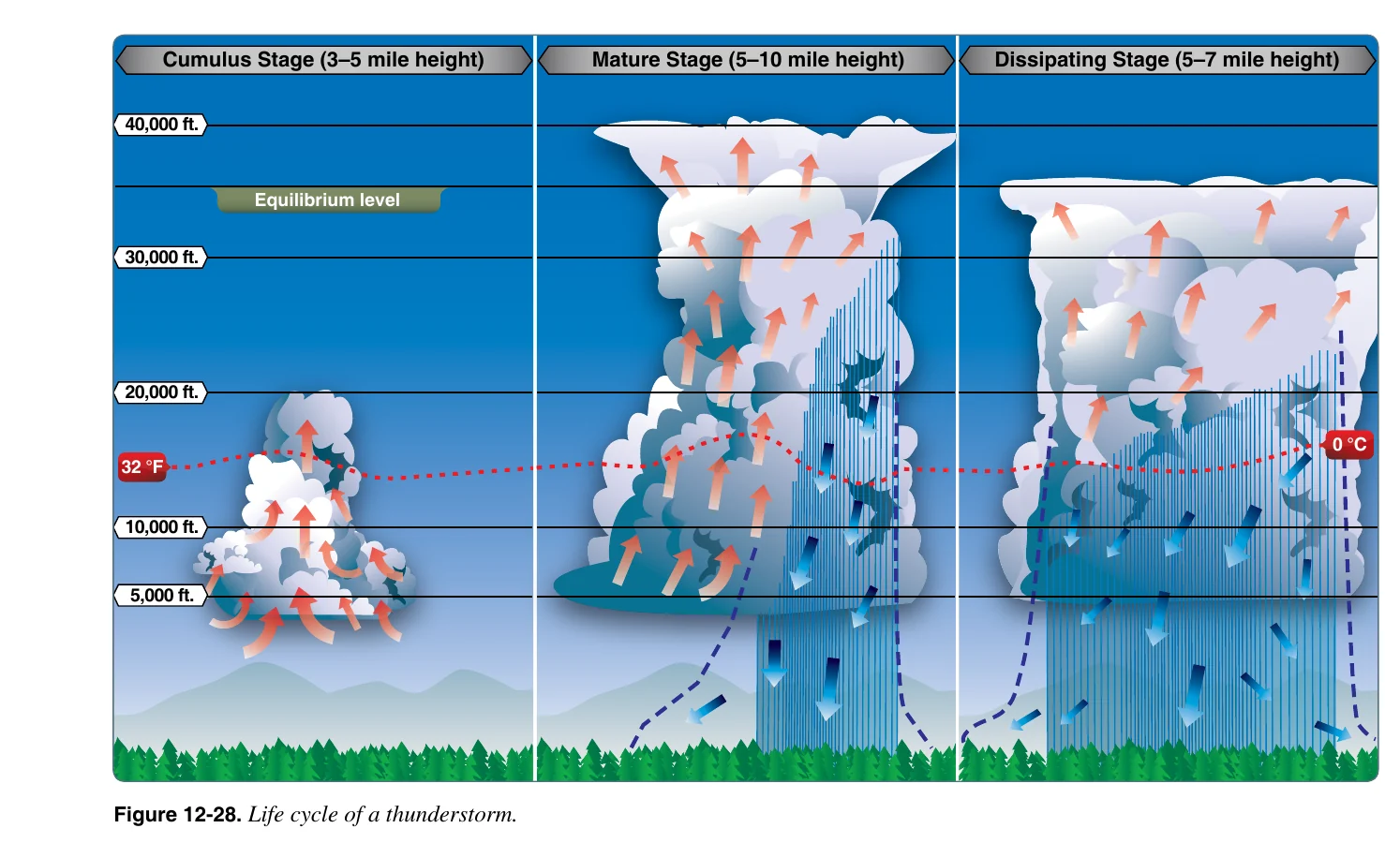
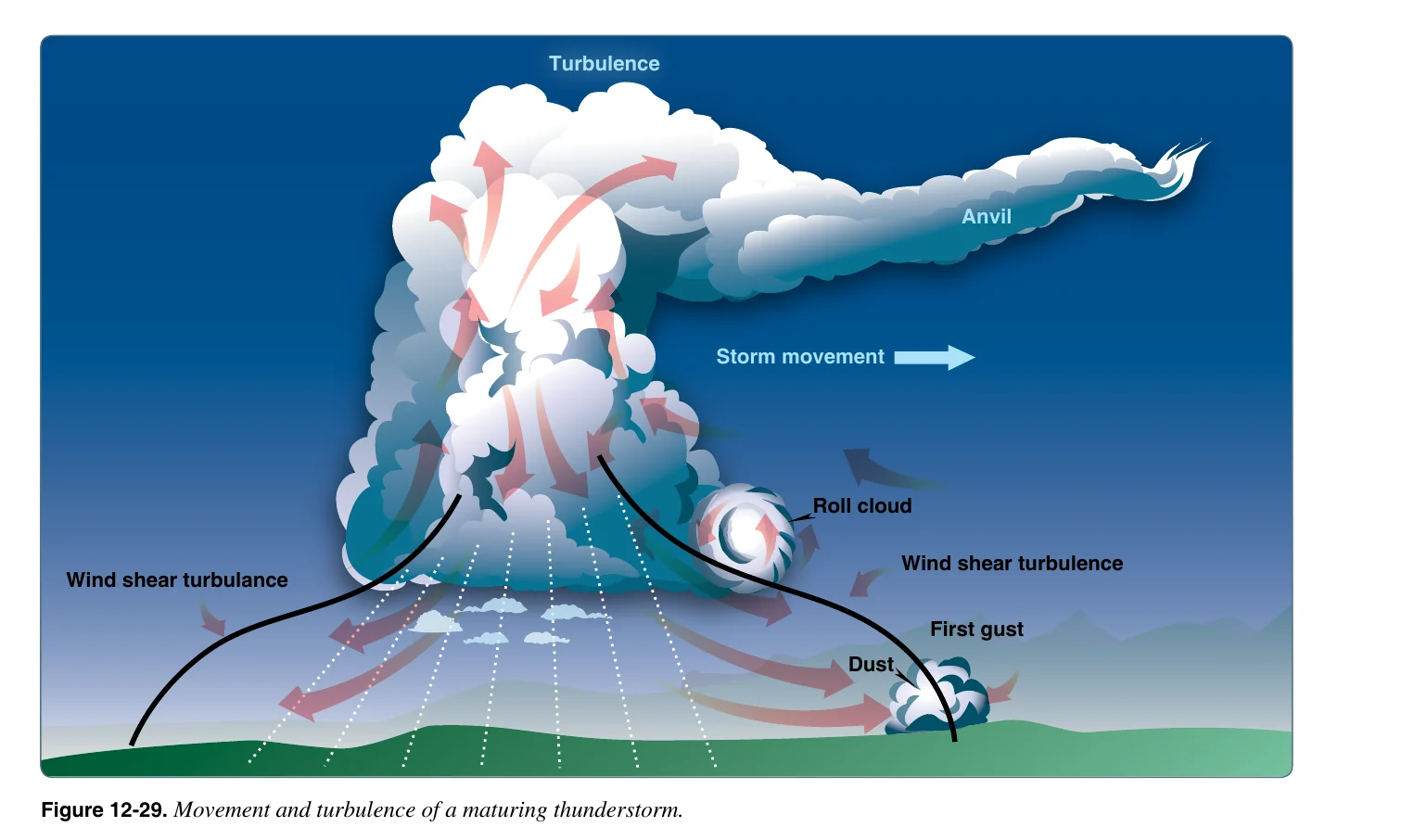
Figures from the FAA Pilot’s Handbook of Aeronautical Knowledge, FAA-H-8083-25C, Chapter 12 (public domain). Companion reading: Aeronautical Information Manual 7-1-26 and 7-1-27. PHAK Chapter 12 (PDF)
Want to work on this in the airplane?
Start the conversation
Book a discovery flight.
Cessna 172 based at KFMN. Instructor and aircraft $265/hr. Ground instruction or instruction in your own airplane $100/hr.